Review · Culture
Terraforming Mars review: a deep engine-builder for serious players
Terraforming Mars is one of the most popular strategy games of the last decade. We look at how it plays, solo mode, expansions, its weaknesses and whether it is worth it in 2026.
 Bitezine Editorial TeamRankings, reviews & guides 8 min read
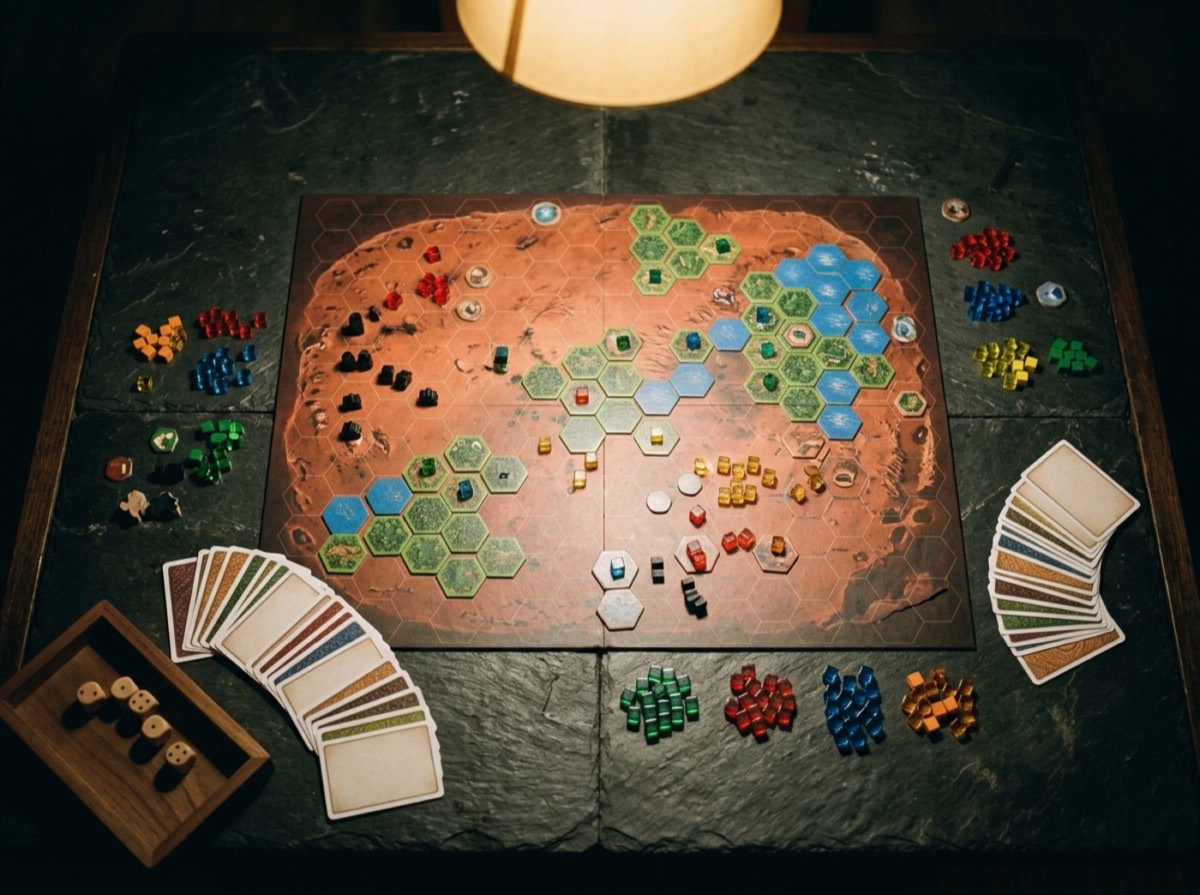 AI generated
 Board game · Mid-range
Terraforming Mars
Terraforming Mars is a rich, thematic engine-builder with enormous replay value, best for patient players who don't mind long games, low interaction and plain components.
What we like
- +Hundreds of unique project cards make every game different
- +Satisfying engine-building with many paths to victory
- +Strong science-based theme woven into the mechanics
- +Plays from 1 to 5 players, including a solo challenge
- +Large range of expansions, with Prelude widely recommended
What could be better
- −Long play time, often two hours or more
- −Thin player boards let cubes slide around
- −Card draws add noticeable luck
- −New players are at a real disadvantage against veterans
- −Limited direct interaction between players
Best for: Strategy fans who enjoy building card combos
Visit FryxGames →Terraforming Mars is one of the defining strategy board games of its era, and this Terraforming Mars review looks at whether it still earns its reputation. Designed by Jacob Fryxelius and released by Swedish family company FryxGames in 2016, it won the Deutscher Spiele Preis in 2017 and spent years near the top of the BoardGameGeek rankings. It has since grown into a full product line with expansions, a card game and digital versions.
This review is based on the publisher's information, independent reviews and player feedback. It covers gameplay, solo mode, expansions, the most common criticisms and who should buy it in 2026.
How Terraforming Mars plays
Each player runs a corporation helping to make Mars habitable. Together, all players raise three global parameters: temperature, oxygen and ocean coverage. The game ends at the end of the generation in which all three reach their targets, so everyone is working toward the same finish line while competing for points.
Each generation, players buy project cards, then take turns doing one or two actions at a time: playing cards, placing cities, greenery and ocean tiles, or using standard projects. Your production of money, steel, titanium, plants, energy and heat pays out at the end of every generation, so early investments snowball.
Points come from your terraform rating, tiles on the map, milestones, awards and many cards. That gives the game plenty of different strategies.
- Raise temperature, oxygen and oceans
- Build production to fund bigger projects
- Place cities and greenery on the Mars map
- Claim milestones and fund awards
Engine building and card combos
The cards are the heart of the game. There are hundreds of different project cards, from asteroid strikes to genetically engineered microbes, and many interact with each other through tags such as space, plant, science or Jovian. Finding a combination that pays off turn after turn is where Terraforming Mars becomes addictive.
Reviewers regularly praise how the theme and mechanics fit together. Releasing heat raises the temperature, plants become greenery that adds oxygen, and ocean tiles give bonuses to adjacent placements. It feels like a science story unfolding on the table.
Weaknesses: length, luck and components
Terraforming Mars is long. The box lists 90 to 120 minutes, but games with four or five players, or new players, often run past two and a half hours. Downtime can also grow as players study their cards.
Card draws matter a lot, and a strong early hand can decide a game. Independent reviewers note that new players are at a clear disadvantage against experienced ones, because knowing the card pool is a big part of skill, and there is little catch-up. Interaction is mostly indirect, through racing for tiles, milestones and awards, plus some cards that reduce opponents' resources.
The original components are functional rather than luxurious. The thin player boards let cubes slide when bumped, which is why FryxGames sells dual-layer boards as an accessory.
Solo mode and player count
The base game includes a solo challenge in which you try to complete terraforming within a fixed number of generations. It is well liked by solo players. In 2024 FryxGames added a dedicated Automa expansion for a solo experience against an artificial opponent.
Many players find two to three players the sweet spot, balancing interaction with a reasonable play time. Five players works but is long.
Expansions, Ares Expedition and digital versions
The expansion range is large. Prelude is the most widely recommended, because it speeds up the slow start by giving each player an extra boost at the beginning. Hellas and Elysium add new maps, Venus Next adds a fourth parameter, Colonies adds trade, and Turmoil adds politics. 2024 brought Prelude 2, new maps and a Milestones and Awards pack.
Terraforming Mars: Ares Expedition (2021) is a shorter, card-driven version with simultaneous turns, suited to players who like the theme but want faster games. A digital adaptation is also available on PC, consoles and mobile.
Who should buy Terraforming Mars?
Terraforming Mars is a great choice for players who have already enjoyed gateway games such as Catan, Ticket to Ride or Wingspan and want something deeper. It suits groups that enjoy planning, reading cards and long sessions. The age rating is 12 and up.
It is not a good pick for casual family nights, players who want lots of direct conflict, or groups with little time. For them, Ares Expedition or a lighter engine-builder may be better.
Key specs
- Designer
- Jacob Fryxelius
- Publisher
- FryxGames (2016), with international partners
- Players
- 1 to 5
- Age
- 12+
- Play time
- 90 to 120 minutes (often longer)
- Components
- Mars board, project and corporation cards, player boards, tiles, resource cubes
- Awards
- Deutscher Spiele Preis 2017 winner, Kennerspiel des Jahres 2017 nominee
Alternatives to consider
- Wingspan: A shorter, prettier engine-builder with a calmer feel and an excellent solo mode.
- Terraforming Mars: Ares Expedition: The same theme with simultaneous turns and a shorter play time.
- Ark Nova: A heavier card-driven engine-builder for players who want even more depth.
Frequently asked questions
Is Terraforming Mars worth buying in 2026?
+
Yes, if you enjoy deep strategy games and long sessions. Its huge card pool and many strategies give it outstanding replay value. Casual groups may prefer a shorter game.
How long does Terraforming Mars take?
+
The publisher lists 90 to 120 minutes. First games and games with four or five players often take two and a half hours or more.
Can you play Terraforming Mars solo?
+
Yes. The base game includes a solo challenge in which you must finish terraforming within a set number of generations, and the 2024 Automa expansion adds an artificial opponent.
What is the best Terraforming Mars expansion?
+
Prelude is the most common recommendation because it speeds up the early game. Hellas and Elysium is a good choice for variety, and Colonies or Turmoil add more interaction.
Is Terraforming Mars good for 2 players?
+
Yes. Many players find two or three players the best balance of interaction and play time, and two-player games are noticeably shorter than five-player ones.
What is the difference between Terraforming Mars and Ares Expedition?
+
Ares Expedition is a card game version with simultaneous phase selection and no shared map. It plays faster and has less downtime, while the original board game offers more spatial strategy and depth.
What age is Terraforming Mars for?
+
The recommended age is 12 and up. The game has a lot of text on its cards and a long play time, so it suits teenagers and adults best.
Terraforming Mars remains one of the most rewarding strategy games you can buy. Its card combos and science theme keep players coming back for dozens of games, even if the length, luck and plain components are real drawbacks. For strategy fans ready to invest an evening, it is still a standout choice in 2026, especially with the Prelude expansion.
How we research: Reviews are based on the maker’s specifications, published independent tests and owner reports. Scores compare the product with others in its class.
Written by
Bitezine Editorial Team
Rankings, reviews & guides
Our editors research every piece from makers’ documentation, independent tests and owner reports, and update it when products change.