Ranked · Food & Drink
Best espresso machines for home in 2026
The ten best home espresso machines for 2026, from budget starters to dual boilers and bean-to-cup automatics, with type, price range and grinder notes.
 Bitezine Editorial TeamRankings, reviews & guides 10 min read
 AI generated
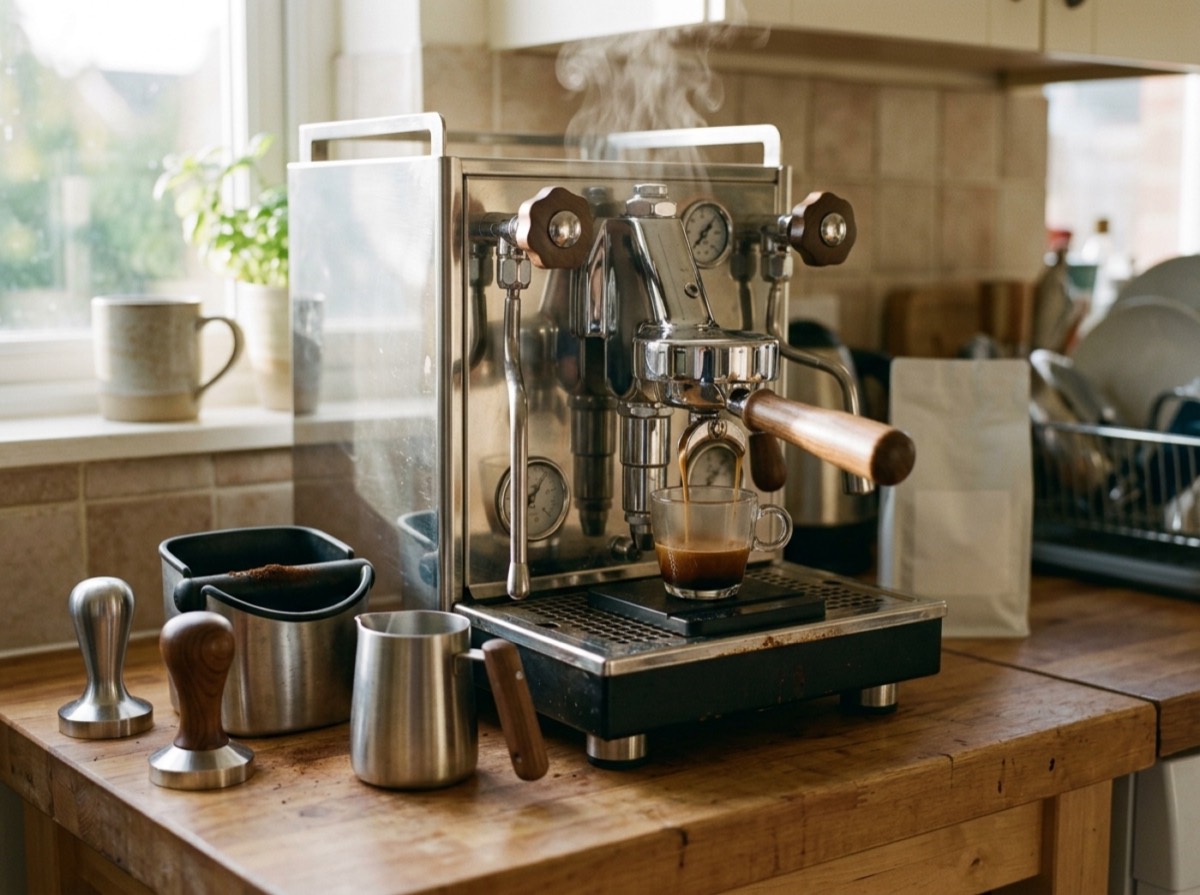
The best espresso machines for home combine stable brewing temperature, enough steam power for milk drinks, and controls that match how hands-on you want to be. This guide covers every level, from an affordable starter machine to prosumer dual boilers and bean-to-cup automatics that grind, tamp and brew at the push of a button.
We reviewed recent tested roundups from independent reviewers and coffee specialists, then checked each machine's current specifications on the manufacturer's own site. We ranked models on shot quality, consistency, milk steaming, ease of use for beginners, build quality and value within their price range. Every machine listed is in production and widely available in 2026.
At a glance

#1 · Best for Beginners who want to learn
Breville Barista Express Impress
The best all-in-one for most people
The Barista Express Impress pairs a built-in conical burr grinder with an assisted tamping lever that measures your dose and tamps it with consistent pressure. That removes the two steps beginners most often get wrong, while still letting you adjust grind size and shot volume as you learn. A manual steam wand lets you practise milk texturing for latte art. It is sold as Sage in the UK and much of Europe.
- Integrated conical burr grinder
- Assisted tamping with dose feedback
- Low-pressure pre-infusion
- Manual steam wand for microfoam
- Type
- Semi-automatic
- Price range
- Mid-range
- Grinder
- Built-in conical burr

#2 · Best for Hands-on hobbyists
Gaggia Classic E24
The classic enthusiast's starter machine
The latest version of the long-running Gaggia Classic (sold as the Classic Pro in North America) uses a brass boiler, a commercial-size 58mm portafilter and a 3-way solenoid valve for dry, easy-to-knock pucks. Its steam wand produces microfoam good enough for latte art. It is simple, repairable and made in Italy, but you will need a separate espresso grinder.
- 58mm commercial-size portafilter
- Brass boiler and group head
- Commercial-style steam wand
- Designed and made in Italy
- Type
- Semi-automatic, single boiler
- Price range
- Mid-range
- Grinder
- None, buy separately
#3 · Best for Small kitchens and latte drinkers
Breville Bambino Plus
Compact, fast and great with milk
The Bambino Plus heats up in about three seconds thanks to Breville's ThermoJet system and takes up very little counter space. Its automatic steam wand textures milk to your chosen temperature and foam level without supervision, which is rare at this price. Pair it with a good grinder for the best results.
- ThermoJet heating, ready in about 3 seconds
- Hands-free automatic milk texturing
- 54mm portafilter with 18g dose
- Small footprint
- Type
- Semi-automatic, thermojet
- Price range
- Budget to mid-range
- Grinder
- None, buy separately

#4 · Best for Experienced home baristas
Lelit Bianca
Pro-level control with flow profiling
The Bianca is a dual boiler machine with a paddle on the group that lets you control water flow during the shot, so you can shape pre-infusion and extraction by hand. An OLED display shows temperatures and shot time, and it can run from its tank or be plumbed in. Wooden accents give it a distinctive look.
- Manual flow control paddle
- Dual boiler with electronic temperature control
- Rotary pump, tank or plumbed-in
- 58mm L58E group
- Type
- Semi-automatic, dual boiler
- Price range
- Premium
- Grinder
- None, buy separately
#5 · Best for Upgraders wanting durability
Rancilio Silvia Pro X
Commercial build in a compact dual boiler
Rancilio's Silvia Pro X uses two boilers with separate PID controllers, so brewing and steam temperatures can be set independently from the display. A soft infusion function wets the puck gently before full pressure, and a pressure gauge helps you dial in. It fits commercial Rancilio components into a body about 25cm wide.
- Dual boiler with two PID controllers
- Soft infusion pre-wetting
- Brew pressure gauge
- Multi-directional steam wand
- Type
- Semi-automatic, dual boiler
- Price range
- Premium
- Grinder
- None, buy separately
#6 · Best for Espresso and cold brew fans
De'Longhi La Specialista Opera
Guided espresso with cold brew
The La Specialista Opera combines a built-in grinder with 15 settings, a lever-operated tamper that applies consistent pressure, and a manual steam wand. It also offers a quick cold brew function using De'Longhi's cold extraction technology. It heats up quickly and is a strong alternative to Breville's all-in-one models.
- Built-in grinder with 15 settings
- Smart tamping lever
- Cold brew in under 5 minutes
- Five preset drinks plus hot water
- Type
- Semi-automatic
- Price range
- Mid-range
- Grinder
- Built-in, 15 settings

#7 · Best for No-compromise home setups
La Marzocco Linea Micra
Café-grade espresso, compact footprint
The Linea Micra is a scaled-down version of La Marzocco's commercial Linea, with dual boilers, an integrated group head and PID control for very stable temperatures. It heats up in about five minutes and can be scheduled and adjusted from the La Marzocco Home app. A 2-litre reservoir makes plumbing optional.
- Dual boilers with integrated group
- Heats up in about 5 minutes
- App control and scheduling
- Convertible portafilter
- Type
- Semi-automatic, dual boiler
- Price range
- Premium
- Grinder
- None, buy separately

#8 · Best for Convenience on a budget
Philips 3200 Series LatteGo
The best-value bean-to-cup machine
The Philips 3200 LatteGo grinds, brews and froths milk at the touch of a button, with a simple touch display and adjustable strength and volume. Its LatteGo milk system has just two parts and no tubes, so it rinses clean in seconds. A ceramic grinder with 12 settings and an AquaClean water filter keep maintenance low.
- One-touch espresso, coffee and milk drinks
- Tube-free LatteGo milk system
- Ceramic grinder with 12 settings
- AquaClean filter reduces descaling
- Type
- Super-automatic
- Price range
- Mid-range
- Grinder
- Built-in ceramic
#9 · Best for Busy households wanting variety
JURA E8
Premium push-button coffee
JURA's best-selling E8 makes a wide range of espresso and milk drinks from a large colour display with minimal effort. Its P.A.G.2 grinder is designed for consistent particle size, and an automatic milk system cleaning function keeps hygiene simple. A smart water filter is detected automatically and tells you when to replace it.
- Wide menu of coffee specialties
- P.A.G.2 professional aroma grinder
- One-touch milk system cleaning
- CLEARYL Smart water filter
- Type
- Super-automatic
- Price range
- Premium
- Grinder
- Built-in P.A.G.2
#10 · Best for Tight budgets and first-timers
De'Longhi Stilosa
The best budget starter
The Stilosa is one of the most affordable ways to make espresso-style drinks at home, with a 15-bar pump, a stainless steel boiler and a manual milk frother. It is compact and easy to clean, though it offers little temperature control compared with pricier machines. It suits occasional lattes and cappuccinos rather than serious espresso.
- 15-bar pump
- Stainless steel boiler
- Manual milk frother
- Compact, easy-clean design
- Type
- Semi-automatic, single boiler
- Price range
- Budget
- Grinder
- None
How to choose
Decide first between semi-automatic and super-automatic. A semi-automatic espresso machine gives you control over grind, dose and tamp, so it has the highest ceiling for flavour and latte art but takes practice. A super-automatic or bean to cup coffee machine does all of that for you, trading some flavour control for speed and convenience. If you are a beginner who wants to learn, an espresso machine with a grinder built in, such as the Breville Barista Express Impress, keeps the setup simple and the counter tidy.
Next, look at the heating system and your milk habits. Single-boiler and thermoblock machines are compact and affordable, but you wait between brewing and steaming. A dual boiler espresso machine brews and steams at the same time with precise temperature control, which matters if you make several milk drinks in a row. Finally, budget for a good grinder if the machine lacks one: fresh, finely and consistently ground beans make a bigger difference than most machine upgrades. A 58mm portafilter also gives you the widest choice of baskets and tampers.
Frequently asked questions
What is the best espresso machine for beginners?
+
The Breville Barista Express Impress is the easiest semi-automatic to learn on, because its built-in grinder and assisted tamping take much of the guesswork out of dosing. If you want no learning curve at all, a super-automatic such as the Philips 3200 LatteGo makes espresso and milk drinks at the touch of a button.
What is the difference between semi-automatic and super-automatic espresso machines?
+
A semi-automatic machine controls water temperature and pressure while you grind, dose, tamp and start and stop the shot. A super-automatic machine grinds, doses, tamps, brews and often froths milk for you. Semi-automatics offer more control and usually better espresso; super-automatics offer speed and convenience.
Do I need a separate grinder for an espresso machine?
+
Yes, unless the machine has one built in. Espresso needs a fine, consistent grind that most blade grinders and pre-ground coffee cannot deliver. Machines without a grinder, such as the Gaggia Classic E24 or Rancilio Silvia Pro X, should be paired with a burr grinder designed for espresso.
Is a dual boiler espresso machine worth it?
+
It is worth it if you make several milk drinks at once or want precise temperature control for different coffees. A dual boiler keeps separate water for brewing and steaming, so you do not wait between steps. For one or two drinks a day, a good single-boiler or thermoblock machine is usually enough.
What bar pressure do I need for espresso?
+
Espresso is traditionally extracted at about 9 bar at the coffee puck. Pumps rated at 15 or 19 bar are common on home machines, but that figure is the pump's maximum, not the brewing pressure. Temperature stability and grind quality matter more than a higher bar number.
Can you make latte art with a home espresso machine?
+
Yes, as long as the steam wand has enough power to create fine microfoam. Machines with commercial-style wands, such as the Gaggia Classic E24, Lelit Bianca and La Marzocco Linea Micra, are well suited to latte art. The Breville Bambino Plus also makes latte-art-ready milk with its automatic wand.
How often should I descale an espresso machine?
+
Most manufacturers recommend descaling every one to three months, depending on how hard your water is and how much you use the machine. Using a water filter or softened water extends the interval. Many automatic machines alert you when descaling is due.
For most people, the Breville Barista Express Impress is the easiest route to good espresso at home, while the Gaggia Classic E24 rewards those willing to buy a separate grinder and learn the craft. If you want café drinks without the skill, a bean-to-cup model from Philips or JURA is the answer. Whichever machine you choose, fresh beans, a consistent grind and regular descaling will do more for your coffee than any single feature.
How we research: We compare each product on the same criteria, using makers’ documentation, independent reviews and owner feedback, and re-check the list when products change.
Written by
Bitezine Editorial Team
Rankings, reviews & guides
Our editors research every piece from makers’ documentation, independent tests and owner reports, and update it when products change.