Review · Culture
Azul review: a tile-laying gem that looks as good as it plays
Azul won the Spiel des Jahres with simple rules, sharp decisions and gorgeous tiles. Here is why it still belongs on family game shelves in 2026.
 Bitezine Editorial TeamRankings, reviews & guides 6 min read
 AI generated
 Board game · Mid-range
Azul
Azul is an elegant, quick and highly replayable abstract game that is easy to teach and hard to put down, though its cutthroat edge and light theme will not suit everyone.
What we like
- +Rules can be learned in minutes
- +Beautiful, weighty resin tiles that are a joy to handle
- +Meaningful decisions and satisfying tactical blocking
- +Plays well at 2, 3 and 4 players
- +Short playing time of around 30 to 45 minutes
What could be better
- −Theme is thin; it is essentially an abstract puzzle
- −Can feel mean when players force penalties on each other
- −Some players may find repeated plays samey without variants
- −Tile bag and cardboard boards are basic compared with the tiles
Best for: Couples, families and quick game nights
Visit Next Move Games (originally Plan B Games; Asmodee) →Azul arrived in 2017 and won the Spiel des Jahres, Germany's family game of the year award, in 2018. Designed by Michael Kiesling, it asks players to decorate the walls of a Portuguese royal palace with azulejo-inspired tiles. Its combination of simple rules, tactile components and tense decisions made it a modern classic, and it has since grown into a whole family of games including Summer Pavilion, Queen's Garden, Stained Glass of Sintra and Azul Duel.
This review focuses on the original Azul. It draws on the publisher's information, independent board game reviews and wider player feedback to explain how it plays, who it suits and whether it is worth buying in 2026.
How to play Azul
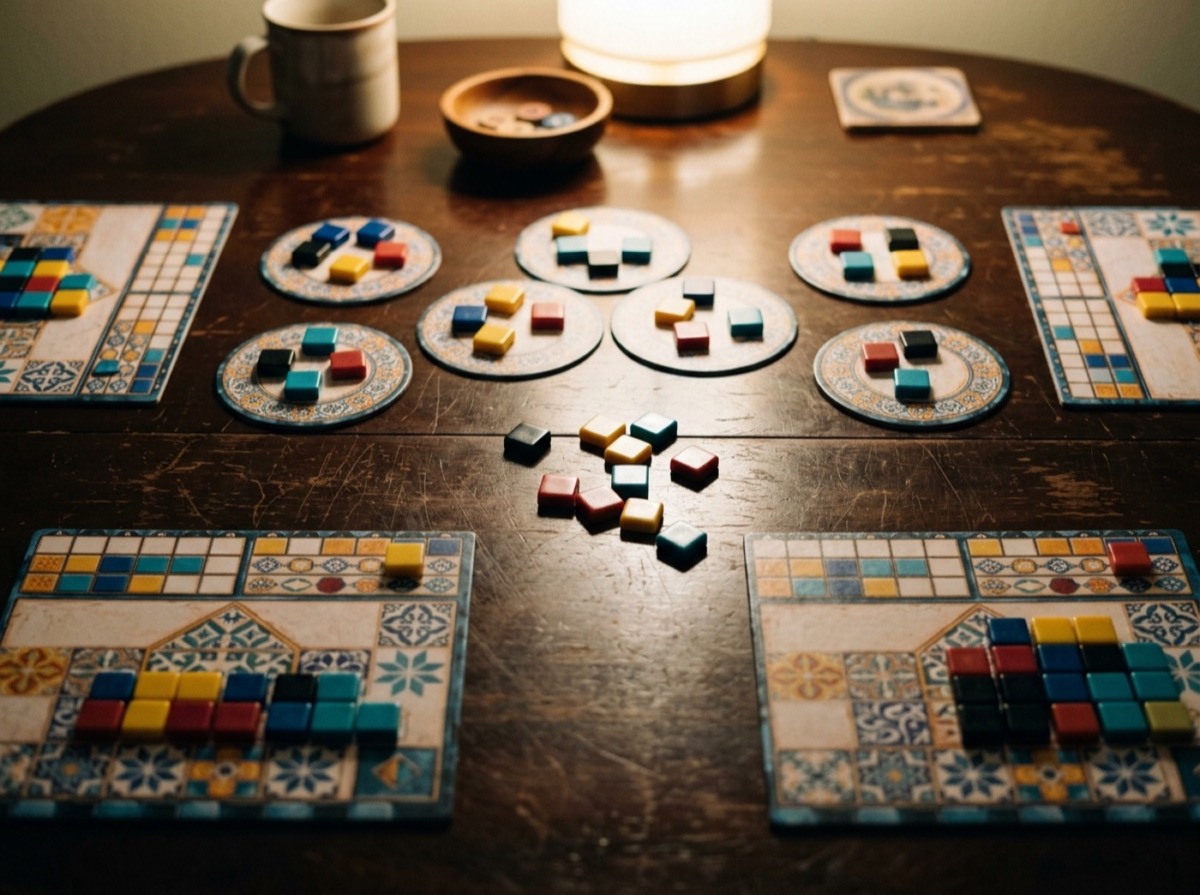
In the centre of the table sit several round factory displays, each holding four tiles drawn from a bag. On your turn, you take all tiles of one colour from a single factory and push the rest to the middle, or you take all tiles of one colour from the middle. You place them on one of the pattern lines on your board.
When a line is full, one tile moves to your wall at the end of the round and scores points for each connected tile. Tiles you cannot place fall to the floor line and cost you points. The game ends when someone completes a horizontal row on their wall, and bonuses reward complete rows, columns and colour sets.
- Draft all tiles of one colour
- Place them on a pattern line
- Move completed lines to your wall and score
- Avoid overflowing tiles that cost points
Components and presentation
The tiles are the star. They are chunky and colourful, and many reviewers highlight how satisfying they are to pick up and place. The rest of the components are simpler: cardboard boards and factories, and a cloth bag. The overall look is bright and inviting, which helps draw non-gamers to the table.
Strategy and the gameplay experience
Azul looks gentle, but it has teeth. Reading what your opponents need and leaving them with bad choices is just as important as building your own wall. Late in a round, players can be forced to take a large number of tiles they cannot use, which creates big point swings.
That interaction is what makes Azul engaging for experienced players, and what some casual players find a little harsh. The reverse side of the player boards offers a variant with a blank wall, letting you choose where each colour goes, which adds planning depth once you know the basics.
Azul with 2, 3 or 4 players
Azul is widely considered an excellent two-player game, with a direct back-and-forth that is easy to plan around. With three or four players the factory count increases and the game becomes more chaotic, as you have less control over what will remain on your next turn. All counts work well, so it is a flexible choice for different groups.
Which Azul should you buy?
The original Azul is the best starting point: it has the cleanest rules and the strongest reputation. Summer Pavilion adds a wild colour and more flexible placement, Stained Glass of Sintra has a different board-building puzzle, and Queen's Garden is heavier. Azul Duel is designed specifically for two players. Smaller travel versions of the original also exist.
Tips for your first games of Azul
New players often focus only on filling their own wall and forget that the floor line can quietly cost a lot of points. Experienced players suggest watching what everyone else needs before each pick, keeping an eye on how many tiles of each colour are left in the centre and taking the first player marker only when the penalty is worth it. Aiming for vertical columns and full colour sets also pays off at the end, because those bonuses are larger than they first appear.
Teaching is simple: one practice round is usually enough for new players to understand scoring. Because turns are quick and the rules are few, Azul also works well with players who do not share a first language, making it a popular choice for mixed groups and travel.
Is Azul worth it?
At a mid-range price, Azul delivers a lot: quick setup, fast games, high replay value and components that feel premium. It is a great gift, a strong first abstract strategy game and a reliable choice for couples. If your group prefers rich themes and storytelling, though, it may feel too dry.
Its compact box and short set-up time also make it an easy game to bring to friends' houses or on holiday.
Key specs
- Designer
- Michael Kiesling
- Publisher
- Plan B Games (2017), now Next Move Games
- Players
- 2 to 4
- Play time
- 30 to 45 minutes
- Age
- 8+
- Components
- 100 resin tiles, player boards, factory displays, scoring markers, bag
- Awards
- Spiel des Jahres 2018
Alternatives to consider
- Ticket to Ride: A friendly route-building game with a stronger theme.
- Wingspan: A deeper engine-builder with a calm nature theme.
- Patchwork: A compact two-player tile-placement puzzle with a quilting theme.
Frequently asked questions
Is Azul good for two players?
+
Yes, many players consider two the best count. The game is tight and strategic, and you can plan around your opponent's options more precisely.
How long does a game of Azul take?
+
Most games take about 30 to 45 minutes. Two-player games are usually on the shorter side.
What age is Azul suitable for?
+
Azul is recommended for ages 8 and up. Younger players can learn the rules quickly, though the scoring and blocking strategy take longer to master.
What is the difference between Azul and Azul: Summer Pavilion?
+
Summer Pavilion uses a star-shaped board, rotating wild colours and more flexible scoring. It is slightly more complex, while the original remains the simplest to teach.
Who designed Azul?
+
Azul was designed by Michael Kiesling and originally published by Plan B Games in 2017. The Azul line is now published by Next Move Games, part of Asmodee.
Can you play Azul online?
+
Yes, the publisher notes that Azul is available to play online on Board Game Arena, which is useful for learning the rules.
Is Azul a good gift?
+
Azul is one of the most popular board game gifts because it is attractive, quick to learn and works for a wide range of ages and group sizes. It suits both families and adults who are new to modern board games.
Azul proves that a great board game does not need complicated rules. Its beautiful tiles, fast turns and sharp tactical choices make it a favourite for couples, families and game groups alike. The theme is light and the interaction can sting, but in 2026 it remains one of the best short strategy games you can put on the table.
How we research: Reviews are based on the maker’s specifications, published independent tests and owner reports. Scores compare the product with others in its class.
Written by
Bitezine Editorial Team
Rankings, reviews & guides
Our editors research every piece from makers’ documentation, independent tests and owner reports, and update it when products change.