Review · Culture
Pandemic review: the co-op game that taught players to work together
Pandemic made cooperative board games mainstream. We look at how it plays, its difficulty, the alpha player problem, Legacy seasons and whether it is worth buying in 2026.
 Bitezine Editorial TeamRankings, reviews & guides 7 min read
 AI generated
 Board game · Mid-range
Pandemic
Pandemic is a tense, well-designed cooperative game that plays well with two and scales in difficulty, though groups need to watch out for one player taking over.
What we like
- +Everyone wins or loses together, which suits mixed groups
- +Excellent with two players
- +Adjustable difficulty through the number of Epidemic cards
- +Seven distinct roles encourage teamwork
- +Clean rules that teach in about 15 minutes
- +Led to the acclaimed Pandemic Legacy series
What could be better
- −Open information makes it easy for one player to direct everyone
- −Experienced players may find the base game solved over time
- −Losses can feel sudden when outbreaks chain
- −The theme may not appeal to everyone
Best for: Couples and groups who prefer teamwork to competition
Visit Z-Man Games →This Pandemic board game review covers one of the most influential games of the century. Matt Leacock's design came out in 2008 and made cooperative play popular with a mass audience. Instead of competing, two to four players work as a disease control team racing to cure four diseases before they spread out of control. The game has sold millions of copies and inspired a long line of spin-offs, including the Pandemic Legacy seasons.
This review is based on the publisher's information, independent board game reviews and player feedback. It covers how Pandemic plays, how hard it is, its main weaknesses and whether it is worth buying in 2026.
How Pandemic plays
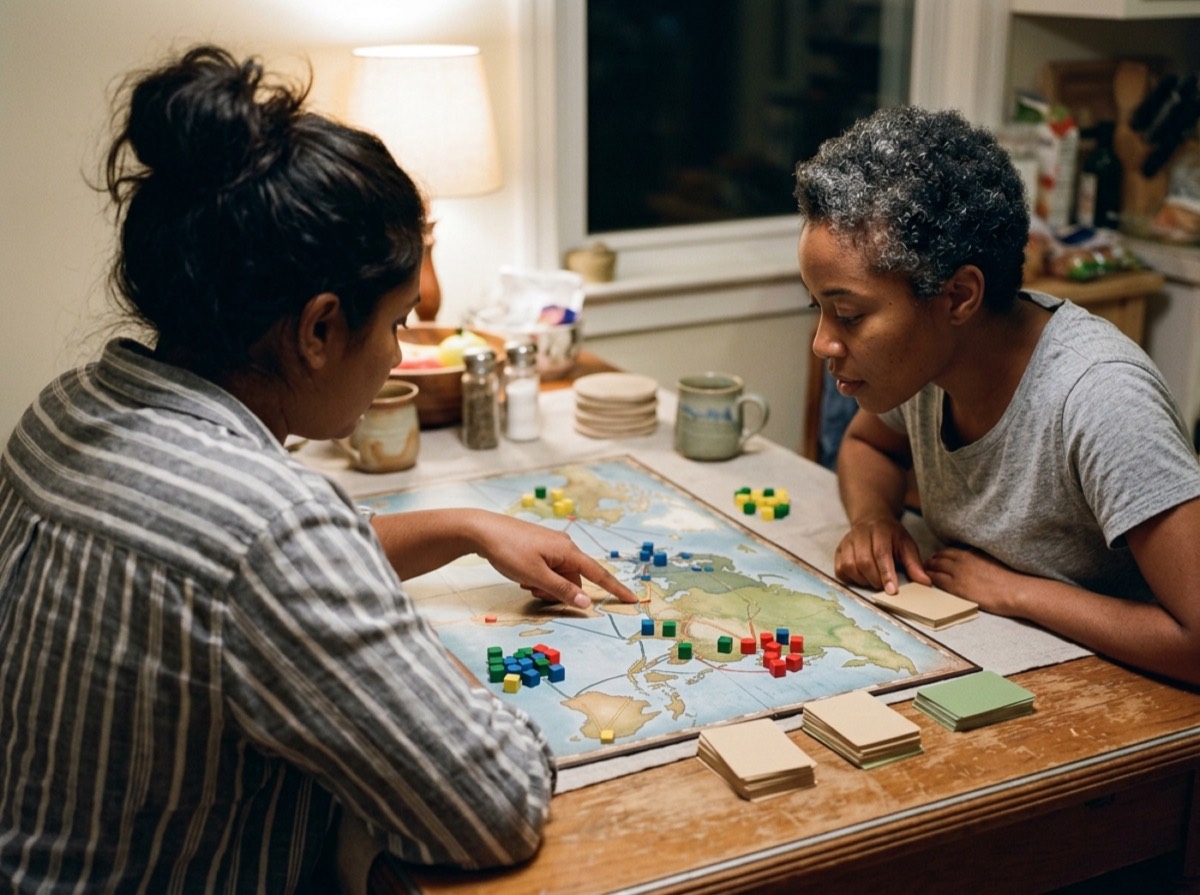
The board shows a world map with 48 cities linked by routes. Four diseases, shown as coloured cubes, start in several cities. Each player takes a role with a special power and gets four actions per turn: move, treat disease, build a research station, share knowledge or discover a cure.
After your actions you draw two player cards, then flip infection cards that add cubes to cities. If a city would get a fourth cube of one colour, it has an outbreak and spreads to all connected cities, which can trigger chain reactions. Hidden in the player deck are Epidemic cards that intensify the infection rate and bring back cities that were already hit.
The team wins by discovering all four cures. You lose if there are eight outbreaks, if a disease runs out of cubes, or if the player deck runs out. That triple threat creates constant pressure.
- Move between cities
- Treat disease cubes
- Build research stations
- Share city cards with a teammate
- Discover a cure with five cards of one colour
Roles and teamwork
The seven roles are what give Pandemic its teamwork. The Medic removes all cubes of a colour at once, the Scientist needs only four cards to cure, the Dispatcher moves other pawns, and the Quarantine Specialist stops infections near them. Combining those powers well is the main strategic puzzle.
Because every game uses a random mix of roles, the best plan changes each time. Talking through turns together is a big part of the fun, and it makes Pandemic a strong choice for groups who don't enjoy beating each other.
Difficulty and replay value
Pandemic lets you set the difficulty by using four, five or six Epidemic cards. Four is a good introduction, while six is genuinely hard even for experienced teams. That range keeps the game interesting longer than many family titles.
Still, regular players often report that the base game becomes predictable after many plays. The expansions On the Brink, In the Lab and State of Emergency add new roles, challenges and a fifth player slot, and are the usual next step for fans.
The alpha player problem
Every open-information co-op faces the same risk: one confident player can end up telling everyone else what to do. In Pandemic this happens easily, because all cards can be shared and discussed. Reviewers and players regularly mention it as the game's biggest social flaw.
It is easy to manage once you know about it. Many groups agree that each player makes the final call on their own turn, or keep their hand of cards private and only describe what they hold.
Pandemic Legacy and spin-offs
Pandemic's success led to Pandemic Legacy: Season 1 (2015), where the board and rules change permanently across a campaign of games. It is widely considered one of the best board games ever made, and was followed by Season 2 (2017) and Season 0 (2020).
There are also many stand-alone spin-offs, including the dice game Pandemic: The Cure, the real-time Rapid Response, the smaller Hot Zone editions and historical games in the Pandemic System line. A digital version existed for several years but is no longer sold on Steam.
Tips for winning at Pandemic
New teams often lose because they spend too many actions treating cubes and too few collecting cards for cures. Treating disease buys time, but only cures win the game, so plan early which player will collect which colour and use the share knowledge action to move cards where they are needed.
Keep an eye on the infection discard pile. After an Epidemic, those same cities are shuffled back on top of the infection deck, so cities with three cubes that were just drawn are the most urgent targets. Building research stations in well-connected cities and keeping pawns spread across the map also helps the team respond quickly.
Finally, remember that running out of player cards is a loss. Moving efficiently and not wasting turns on low-value actions matters, because the clock is always ticking.
Who should buy Pandemic?
Pandemic is ideal for couples, because it plays excellently with two, and for families with children aged 8 or older who enjoy working as a team. It is also a great first co-op game for people who normally avoid competitive games.
If you already know you love the system and want a longer experience, consider starting directly with Pandemic Legacy: Season 1. If you want something shorter and lighter, the Hot Zone editions are a good choice.
Key specs
- Designer
- Matt Leacock
- Publisher
- Z-Man Games (first released 2008)
- Players
- 2 to 4 (solo variant available)
- Age
- 8+
- Play time
- About 45 minutes
- Components
- Board, 7 roles, 59 player cards, 48 infection cards, 96 disease cubes
- Type
- Cooperative
Alternatives to consider
- Pandemic Legacy: Season 1: The same core game turned into an evolving campaign that many rank among the best board games ever.
- Forbidden Island: A lighter and cheaper co-op game from the same designer that suits younger kids.
- The Crew: A compact cooperative card game where limited communication avoids the alpha player problem.
Frequently asked questions
Is Pandemic a good board game for 2 players?
+
Yes. Pandemic plays very well with two, and many couples consider it one of the best co-op games for two. The game is fast and each player's role matters a lot.
Can you play Pandemic solo?
+
The publisher offers a solo rules variant. Many solo players also simply control two or more roles themselves, which works well because all information is open.
How hard is Pandemic?
+
It depends on the number of Epidemic cards: four is the introductory level and six is the heroic level. New teams often lose their first games, which is part of the challenge.
What age is Pandemic suitable for?
+
The official age rating is 8 and up. Children at that age usually need help with planning, but the cooperative format makes it easy for adults to guide them.
Should I buy Pandemic or Pandemic Legacy first?
+
If you are new to board games, start with the base game to learn the rules. If your group is committed to playing 12 to 24 sessions together, Pandemic Legacy: Season 1 offers a richer experience and teaches the same core rules.
How long does Pandemic take to play?
+
The publisher lists about 45 minutes. Setup takes around 10 minutes, and first games usually run longer.
Pandemic remains one of the best cooperative board games you can buy. It is tense, social and easy to learn, and it plays especially well with two. Keep the alpha player problem in check and it will serve as a reliable game night staple for years, with the Legacy seasons waiting when you want more.
How we research: Reviews are based on the maker’s specifications, published independent tests and owner reports. Scores compare the product with others in its class.
Written by
Bitezine Editorial Team
Rankings, reviews & guides
Our editors research every piece from makers’ documentation, independent tests and owner reports, and update it when products change.