Guides
How to sharpen a kitchen knife: whetstone, pull-through sharpener and honing steel
How to sharpen a kitchen knife at home with a whetstone or pull-through sharpener, what angle to use, and why honing and sharpening are not the same thing.
 Bitezine Editorial TeamRankings, reviews & guides 6 min read
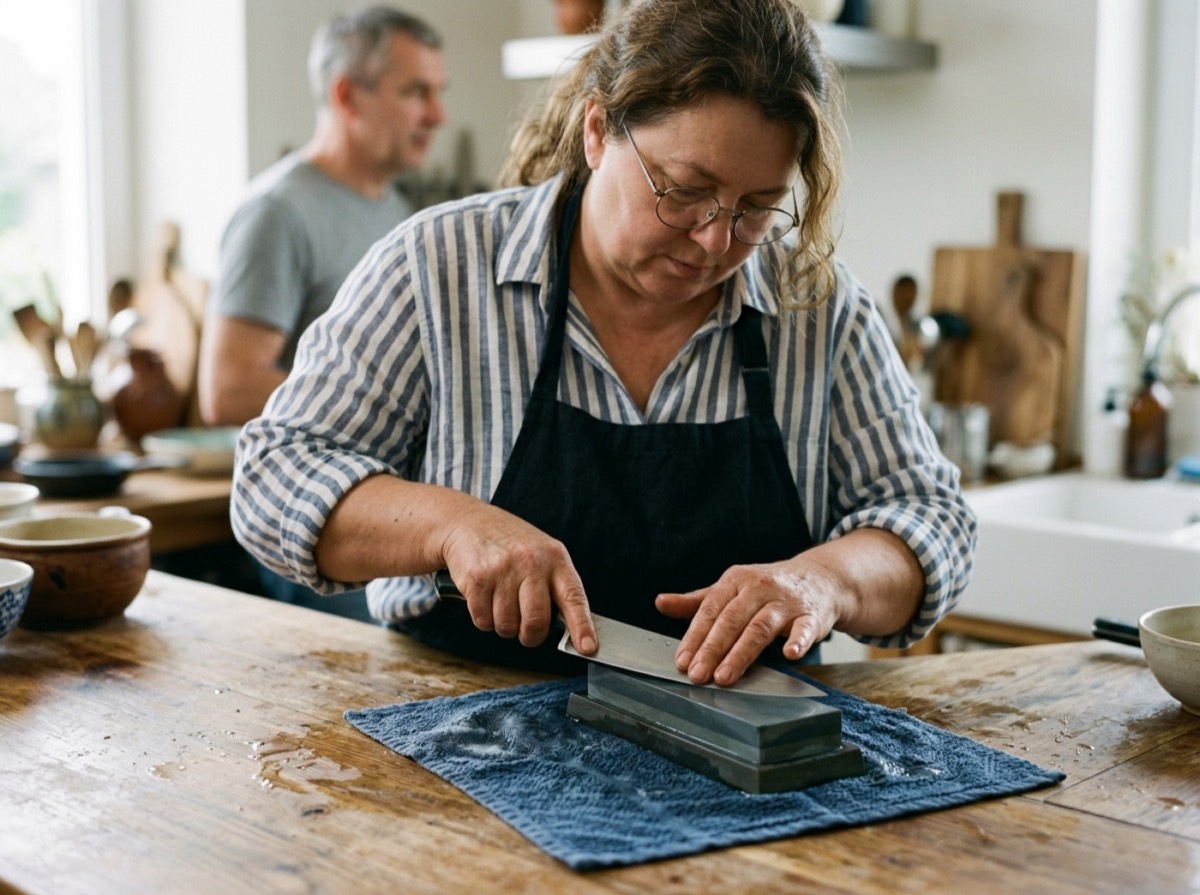 AI generated
Knowing how to sharpen a kitchen knife makes cooking faster, safer and far more pleasant. A sharp blade glides through tomatoes and onions with little pressure, while a dull one slips off the skin and heads toward your fingers. The good news is that you do not need special skills: a whetstone, a steady angle and ten minutes are enough.
This guide explains the difference between honing and sharpening, how to use a whetstone step by step, when a pull-through sharpener makes sense and how to keep an edge sharp for longer.
Honing vs sharpening: what is the difference?
A knife edge is extremely thin. In use, it bends and rolls slightly to one side, so the knife feels dull even though the metal is still there. Honing on a steel or ceramic rod pushes that rolled edge back into line. It removes little or no metal and can be done every few uses.
Sharpening grinds away metal to create a new edge. It is needed when honing no longer brings the blade back. For most home cooks, that means sharpening a few times a year and honing regularly in between.
How to tell if your knife needs sharpening
Try slicing a sheet of printer paper held in the air. A sharp knife cuts cleanly; a dull one tears or snags. A ripe tomato is another good test: the blade should bite into the skin without pressing. If honing does not fix a tearing cut, it is time to sharpen.
You can also look at the edge under a bright light. Shiny spots or glints along the very edge are flattened, dull areas that reflect light.
A steady angle matters more than the exact number of degrees.
What angle should you sharpen a kitchen knife at?
Most kitchen knives are sharpened at roughly 15 to 20 degrees per side. Traditional Western knives, made from somewhat softer steel, are usually closer to 20 degrees, which gives a sturdier edge. Many Japanese knives use harder steel that can hold a finer edge of around 15 degrees. If you are unsure, check the maker's guidance or follow the existing bevel you can see on the blade.
Consistency matters more than the exact number. A simple trick: hold the blade at 90 degrees to the stone, halve that to 45, halve again to about 22, then lower slightly. Some people stack two coins under the spine as a visual guide at first.
Choosing a whetstone grit
Whetstones are graded by grit: the lower the number, the coarser the stone. A combination stone with a medium side and a fine side covers most home needs.
- Coarse (around 200 to 600): repairs chips and very dull, damaged edges.
- Medium (around 800 to 2000): everyday sharpening of a dull knife.
- Fine (around 3000 to 8000): refines and polishes the edge for smoother cuts.
How to sharpen a knife with a whetstone, step by step
Read the stone's instructions first. Many water stones need soaking for 10 to 15 minutes until bubbles stop; splash-and-go stones only need wetting. Oil stones use honing oil instead of water.
- Place the stone on a damp towel or non-slip base, coarser side up.
- Hold the handle firmly and rest the fingertips of your other hand flat on the blade, well away from the edge.
- Set your angle and push the blade across the stone, edge first, sweeping from heel to tip so the whole edge makes contact.
- Use light, even pressure and keep the stone wet. Repeat 10 to 20 strokes.
- Feel carefully for a burr: a tiny rough lip along the opposite side of the edge. Stroke away from the edge, never along it.
- Once there is a burr along the full length, switch sides and repeat.
- Move to the finer grit and repeat both sides with fewer, lighter strokes.
- Finish with a few alternating single strokes, then a light pass on a honing rod or a leather strop to remove the burr.
- Wash and dry the knife, rinse the stone and let it air dry.
Pull-through sharpeners and electric sharpeners
Pull-through sharpeners use fixed slots with abrasive wheels or carbide blades. They are quick and need no skill, which makes them a reasonable choice for inexpensive knives. The downside is that they remove more metal than needed, can leave a rougher edge and do not suit every blade angle. Carbide slots in particular can be harsh on thin Japanese knives.
Electric sharpeners are faster still but aggressive. If you use one, pull the knife through slowly and evenly and stop as soon as the edge is restored. Check the guidance for your knives before using either type on expensive or hard-steel blades.
How to use a honing steel
Stand the rod upright with its tip on a folded towel. Place the heel of the knife against the top of the rod at your sharpening angle and draw the blade down and toward you, so the whole edge touches the rod. Alternate sides for five or six light strokes each. Speed is not important; a steady angle is. Ceramic rods have a slight abrasive effect and suit harder steels better than grooved steel rods.
Safety tips and keeping knives sharp longer
Always move your fingers with the knife, never in front of the edge, and work on a stable surface. Wipe metal filings off the blade before cooking. Never test sharpness by running a finger along the edge.
To keep an edge longer, cut on wood or plastic boards rather than glass, stone or ceramic. Wash knives by hand, dry them straight away and store them on a magnetic strip, in a block or with blade guards rather than loose in a drawer. Serrated knives dull slowly and need a tapered rod to sharpen each scallop; if in doubt, use a professional service.
Frequently asked questions
How often should I sharpen my kitchen knives?
+
For most home cooks, sharpening two to four times a year is enough, with regular honing in between. Knives used heavily every day may need it more often.
What angle should I sharpen my kitchen knife at?
+
Roughly 15 to 20 degrees per side. Western knives are typically closer to 20 degrees and many Japanese knives around 15 degrees. Holding the same angle consistently matters most.
Does a honing steel sharpen a knife?
+
Not really. A honing steel realigns a bent edge, which makes the knife feel sharp again, but it removes little or no metal. When honing stops working, the knife needs real sharpening.
Are pull-through knife sharpeners bad for knives?
+
They are convenient but remove more metal than a whetstone and can leave a coarser edge. They are fine for budget knives; for good or Japanese knives, a whetstone gives better, longer-lasting results.
What grit whetstone is best for beginners?
+
A combination stone with a medium side around 1000 grit and a fine side around 3000 to 6000 grit handles most kitchen knives. Add a coarse stone only if you need to repair chips.
Do I need to soak my whetstone?
+
It depends on the stone. Traditional water stones need soaking until bubbles stop, splash-and-go stones only need wetting, and oil stones use honing oil. Follow the maker's instructions.
Why is my knife still dull after sharpening?
+
Usually the edge never fully met in the middle because no burr formed along the whole length, or the angle changed during strokes. Go back to the coarser grit, raise a burr from heel to tip, then refine.
Sharpening a kitchen knife is a skill that improves with each session. Start with an inexpensive knife, keep a steady angle, work until you feel a burr along the whole edge, then refine and hone. With regular honing and proper storage, a well-sharpened knife stays reliable for months, and every meal becomes a little easier to prepare.
How we research: Guides are written from established sources and checked for accuracy. They are general information, not professional advice.
Written by
Bitezine Editorial Team
Rankings, reviews & guides
Our editors research every piece from makers’ documentation, independent tests and owner reports, and update it when products change.