Tech
How to choose a TV size for your room and viewing distance
How big should your TV be? Use viewing distance, resolution and room layout to choose a TV size that feels immersive without overwhelming the space.
 Bitezine Editorial TeamRankings, reviews & guides 6 min read
 AI generated
Choosing a TV size is the decision most buyers get wrong, and almost always in the same direction: too small. A screen that looks huge in the shop, next to walls of even larger models, often feels modest once it is on your wall. The simplest way to decide how to choose a TV size is to measure how far you sit from the screen and work from there.
This guide explains how screen size is measured, the viewing distance rules used by cinema and broadcast standards, how resolution changes the picture, and the practical checks that stop a new TV from dominating or disappointing your room.
How TV size is measured
TV sizes are given in inches and measured diagonally across the visible screen, from one corner to the opposite corner. One inch is 2.54 centimetres, so a 55-inch TV has a diagonal of about 140 cm.
The diagonal can be misleading because the width is what you notice on a wall or cabinet. For the standard 16:9 shape, the screen width is roughly 87 percent of the diagonal and the height about 49 percent. The outer case adds a little more, though modern bezels are thin.
- 55-inch: screen about 122 cm wide and 68 cm high
- 65-inch: screen about 144 cm wide and 81 cm high
- 75-inch: screen about 166 cm wide and 93 cm high
What size TV should I get for my viewing distance?
The most useful guidance comes from viewing angle: how much of your field of vision the screen fills. The Society of Motion Picture and Television Engineers (SMPTE) recommends a screen that fills about 30 degrees of your view, which works out to a viewing distance of roughly 1.6 times the diagonal. THX, known for cinema certification, suggests about 40 degrees for a more immersive feel, which means sitting at roughly 1.2 times the diagonal.
To turn that around, measure the distance from your eyes to the screen position in inches and divide by 1.6 for a comfortable size, or by 1.2 for a cinematic size. Anything between the two results is a sensible choice.
- About 1.5 m (59 in) away: roughly 37 to 49 inches
- About 2 m (79 in) away: roughly 49 to 65 inches
- About 2.5 m (98 in) away: roughly 61 to 82 inches
- About 3 m (118 in) away: roughly 74 to 98 inches
- About 3.5 m (138 in) away: roughly 86 inches and up
A TV that looks huge in the shop often feels modest once it is on your own wall.
How resolution affects the ideal TV size
Older advice told people to sit far from large screens so they would not see individual pixels. That made sense with standard definition and even with Full HD, where sitting too close reveals a soft, grainy image.
With 4K resolution, which is standard on most mid-size and large TVs, pixels are four times as dense as on Full HD. Based on normal visual acuity, a 4K screen can be viewed from about 1.6 times the screen height, far closer than Full HD, before the pixel structure becomes visible. In practice, that means you can choose a bigger 4K TV for the same room, or sit closer, without the picture looking rough.
Content quality still matters. Low-quality streams and old broadcasts look softer on a very large screen, so if you mostly watch standard-definition channels, lean toward the smaller end of the range.
Can a TV be too big for a room?
Yes, though it happens less often than people fear. A screen that is too large for the distance forces you to move your eyes and head to follow the action, which can be tiring, especially with fast sports or games. Fast-moving content may also show more visible motion artefacts up close.
The other limit is physical. A large TV can overpower a small room visually, block a window or simply not fit the wall. If you are torn between two sizes and the larger one fits your distance range and your space, most owners are happier with the larger one within a few weeks.
Check your space before you buy
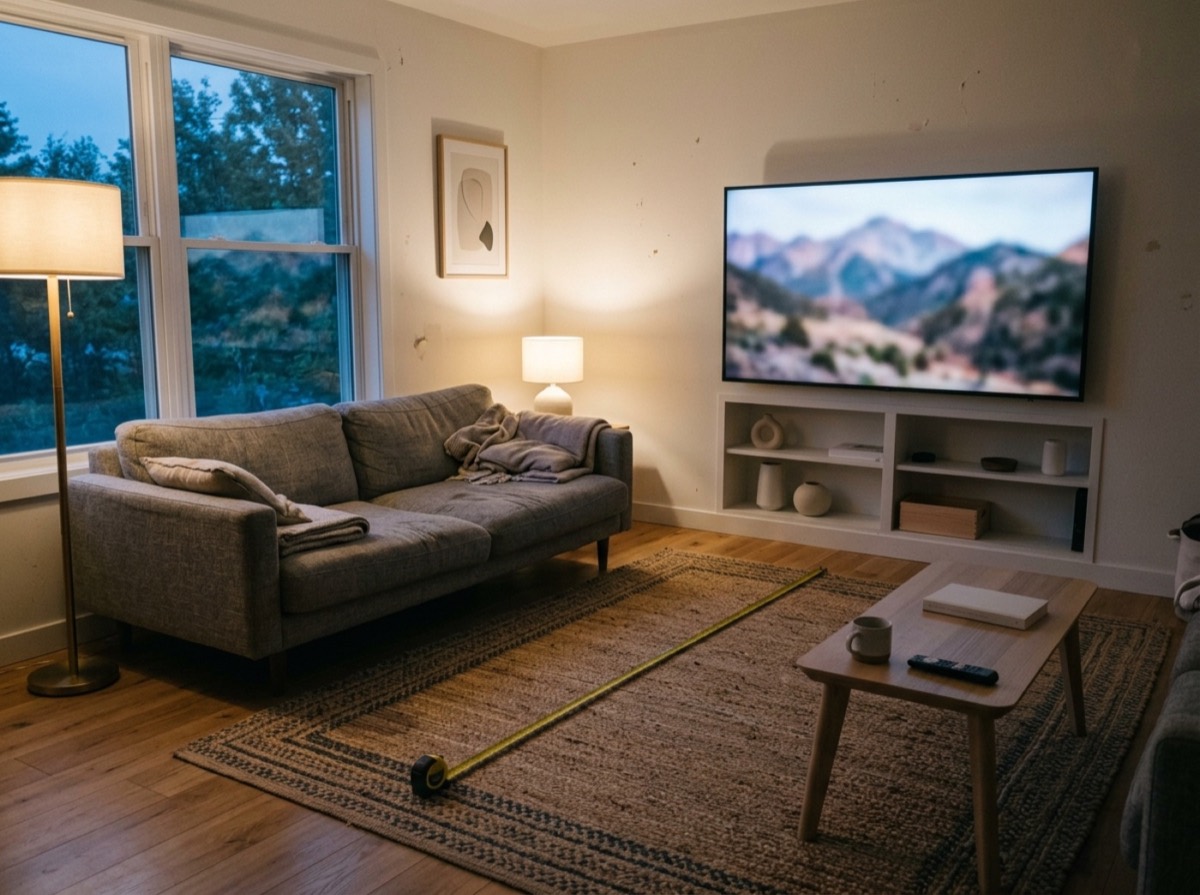
Measure the actual spot, not just the room. Mark the TV's full width and height on the wall with painter's tape or cut a piece of cardboard to size. Living with the outline for a day is the quickest way to know whether it feels right.
If the TV will stand on furniture, compare the positions of the feet with your cabinet. Some TVs have feet near the outer edges and need a stand almost as wide as the screen. For wall mounting, check the VESA mounting pattern and the weight rating of the bracket and wall.
- Measure eye-to-screen distance from your main seat
- Check wall width, cabinet width and foot positions
- Look at the stand height; the screen centre should sit near eye level when seated
- Consider windows and lamps that may reflect on a larger screen
- Confirm the TV fits through doors and stairways in its box
Mounting height and seating angle
Size and height work together. For comfortable viewing, the centre of the screen should be close to eye level when you are seated, often around a metre from the floor. Mounting a large TV high above a fireplace forces you to look up, which strains the neck over long sessions.
Also think about where people sit. Viewers far off to the side see some loss of contrast and colour on many screens, especially LCD models. In wide rooms, a slightly smaller screen that everyone sees well can beat a larger one viewed at a sharp angle.
Recommended TV sizes for different rooms
Every home is different, but some patterns are common. Bedrooms and kitchens tend to have shorter viewing distances and less wall space, so 32 to 50 inches usually fits. Living rooms with seating two to three metres away suit 55 to 75 inches. Dedicated media rooms and large open spaces are where 75 inches and above, or a projector, make sense.
Gamers often sit closer than film watchers, so a mid-size screen at desk or sofa distance can feel just as immersive as a much larger one across the room.
Frequently asked questions
What size TV should I get for a 3 metre viewing distance?
+
At about 3 metres (118 inches), the common viewing-angle rules point to roughly 74 to 98 inches. A 75-inch or larger 4K TV fits comfortably, while 65 inches will feel less immersive but still works for smaller rooms.
How far should you sit from a 65-inch TV?
+
Using the SMPTE and THX guidelines, roughly 2 to 2.6 metres (about 78 to 104 inches) is a good range for a 65-inch screen. With 4K content, sitting toward the closer end still gives a sharp picture.
Is a 65-inch TV too big for a small living room?
+
Not if you sit at least about 2 metres away and the wall or cabinet can fit a screen roughly 145 cm wide. Mark the outline on the wall with tape to see how it feels before buying.
Is a TV measured diagonally?
+
Yes. The size in inches is the diagonal of the visible screen, corner to corner. Width and height are smaller, so check the listed dimensions to see whether it fits your space.
What is a good TV size for a bedroom?
+
Most bedrooms suit 32 to 50 inches, depending on the distance from the bed. Divide the distance in inches by 1.6 for a comfortable size, and consider mounting height so you are not looking up.
Does 4K let you sit closer to the TV?
+
Yes. Because 4K has four times the pixels of Full HD, individual pixels stay invisible at much shorter distances. That allows a larger screen in the same room without a grainy image, provided the content is good quality.
The easiest way to choose a TV size is to measure your viewing distance, divide it by 1.6 and 1.2, and pick a screen within that range that fits your wall or cabinet. With 4K, you can comfortably go toward the larger end. Tape the outline to the wall before ordering, and you will end up with a TV that feels right from the first evening.
How we research: Guides are written from established sources and checked for accuracy. They are general information, not professional advice.
Written by
Bitezine Editorial Team
Rankings, reviews & guides
Our editors research every piece from makers’ documentation, independent tests and owner reports, and update it when products change.