Money
Compound interest explained simply, with examples
Compound interest explained in plain words: how interest on interest works, the formula, the rule of 72, worked examples and why it matters for savings and debt.
 Bitezine Editorial TeamRankings, reviews & guides 5 min read
 AI generated
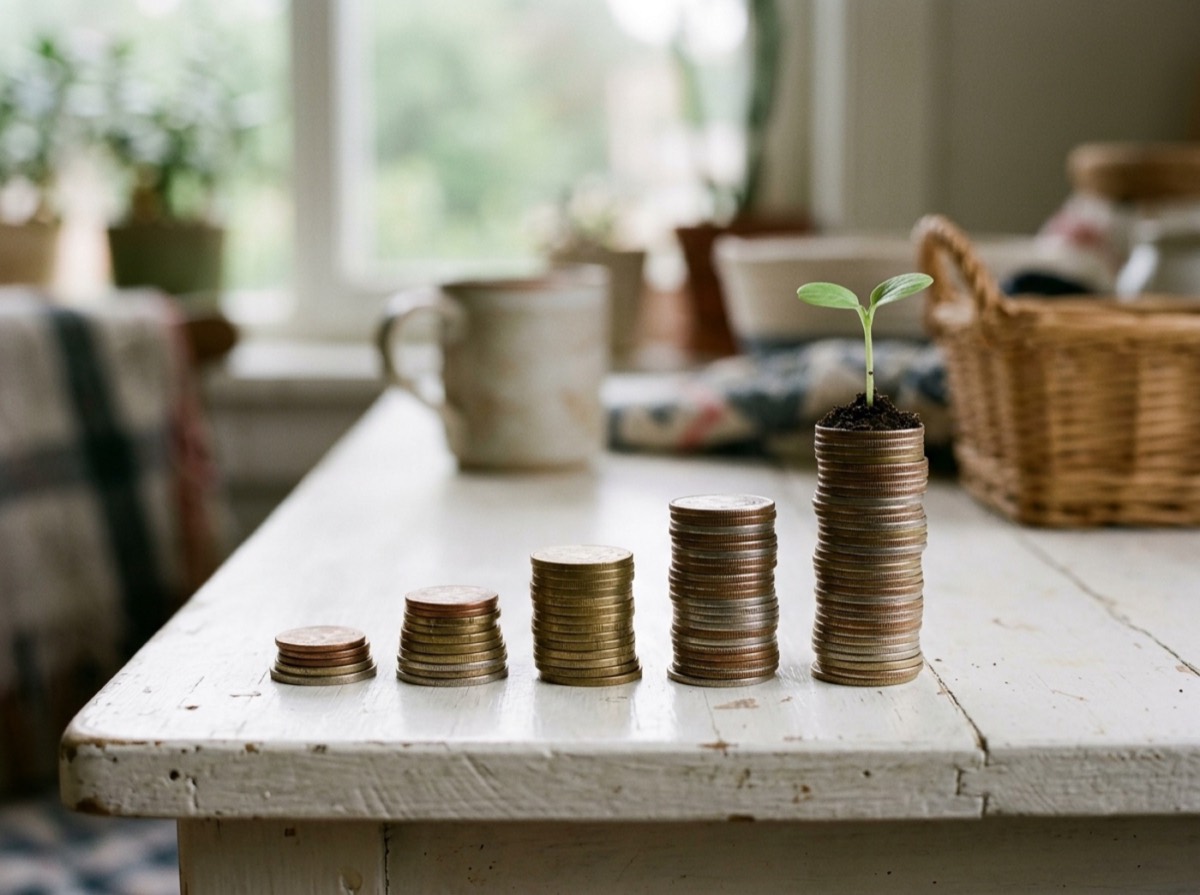
Compound interest explained in one sentence: you earn interest not only on the money you put in, but also on the interest that money has already earned. Over time, that interest on interest makes savings grow faster and faster, which is why it is often called the most powerful idea in personal finance.
This article shows how compound interest works, the formula behind it, a quick mental shortcut and why the same force can work against you when you borrow. It is general information, not financial advice, and the numbers are illustrations, not predictions of real returns.
What is compound interest?
When you save or invest money, it can earn a return. With compound interest, that return is added to your balance, and the next round of interest is calculated on the new, larger balance. Each period, the base grows a little, so the amount of interest grows too.
The effect is small at first and dramatic later. In the early years, most of your balance is the money you paid in. After a long time, a large share can be growth, which is why time is the most important ingredient.
Simple vs compound interest
Simple interest is paid only on the original amount. If you deposit 1,000 euros at 5 percent simple interest, you earn 50 euros every year, no matter how long you wait. After 20 years you have 2,000 euros.
With 5 percent compounded once a year, the first year also brings 50 euros. The second year, though, pays 5 percent on 1,050 euros, which is 52.50 euros. The gap keeps widening: after 20 years the balance is about 2,653 euros, and after 40 years about 7,040 euros, compared with 3,000 euros under simple interest.
Compound interest rewards time more than it rewards cleverness.
The compound interest formula
The standard formula for periodic compounding is A = P × (1 + r/n)^(n × t). It looks technical but has only five parts.
You do not need to calculate this by hand. Any spreadsheet or online compound interest calculator will do it, but knowing the parts helps you see which levers matter: the rate, the time and how often interest is added.
- A: the final amount.
- P: the principal, the money you start with.
- r: the annual interest rate as a decimal, so 5 percent is 0.05.
- n: how many times per year interest is added, such as 1 for yearly or 12 for monthly.
- t: the number of years.
The rule of 72: how long to double your money
The rule of 72 is a quick way to estimate how long compound growth takes to double a sum. Divide 72 by the annual rate in percent. At 6 percent, money doubles in about 12 years; at 8 percent, in about 9; at 3 percent, in about 24.
The shortcut is old. It already appears in Luca Pacioli's mathematics book Summa de arithmetica, printed in Venice in 1494. It is most accurate for rates in the mid single digits and less precise at very high rates, but it is close enough for everyday thinking.
It also works in reverse for costs. With inflation at 3 percent, prices roughly double in 24 years, which shows why money left without any return slowly loses buying power.
Why compounding frequency matters
Interest can be added yearly, quarterly, monthly or even daily. The more often it is added, the sooner each bit of interest starts earning its own interest, so the final amount is slightly higher at the same headline rate.
To compare offers fairly, look at the effective annual rate, which already accounts for compounding frequency. Banks in many countries must show a comparable figure, sometimes labelled the annual equivalent rate or annual percentage yield. For savers, the difference between monthly and yearly compounding is usually modest; the rate and the time invested matter far more.
Why starting early makes such a difference
Because growth builds on growth, the years at the beginning are the most valuable. Imagine two savers who each put away the same amount every month at the same average return. One starts ten years earlier and stops adding money at the point the other begins. Depending on the rate, the early starter can still end up with a similar or even larger pot, despite paying in far less in total.
The lesson is not that late starters should give up. It is that the best time to begin is as soon as you reasonably can, even with small amounts, and that regular contributions matter as much as the rate.
- Start early, even with a small monthly amount.
- Contribute regularly and automatically.
- Reinvest returns rather than spending them.
- Keep costs and fees low, because fees compound too.
- Be patient: most of the growth arrives in the later years.
Compound interest on debt: the other side
Compounding works just as hard for lenders. When unpaid interest on a credit card or overdraft is added to the balance, you start paying interest on interest. High rates make this especially costly, and paying only the minimum can stretch a modest balance over many years.
This is why paying down expensive debt is often compared to earning a guaranteed return equal to its interest rate. Clearing high-interest balances first stops compounding from working against you.
Frequently asked questions
What is compound interest in simple terms?
+
Compound interest is interest earned on both your original money and the interest it has already earned. Because the balance keeps growing, each period's interest is a little larger than the last.
What is the difference between simple and compound interest?
+
Simple interest is calculated only on the original amount, so it stays the same each year. Compound interest is calculated on the growing balance, so the yearly interest increases over time and the total grows much faster.
How do I calculate compound interest?
+
Use the formula A = P × (1 + r/n)^(n × t), where P is the starting amount, r the annual rate, n the number of compounding periods per year and t the number of years. A spreadsheet or online calculator can do the maths for you.
What is the rule of 72?
+
The rule of 72 estimates how many years it takes to double your money: divide 72 by the annual rate in percent. At 6 percent, for example, money doubles in roughly 12 years.
Does monthly compounding make a big difference?
+
It makes some difference, because interest starts earning interest sooner, but for typical savings rates the gain over yearly compounding is modest. The interest rate and how long you save have a much bigger effect.
Do investments like ETFs compound?
+
Investments do not pay a fixed interest rate, but reinvested returns and dividends grow in a similar way over time. Returns vary from year to year and can be negative, so the growth is not guaranteed.
Compound interest rewards time, consistency and patience. Start saving as early as you can, reinvest what your money earns, keep fees low and clear expensive debt so compounding works for you rather than against you. The formula is simple; the hard part is giving it enough years to do its work.
How we research: Guides are written from established sources and checked for accuracy. They are general information, not professional advice.
Written by
Bitezine Editorial Team
Rankings, reviews & guides
Our editors research every piece from makers’ documentation, independent tests and owner reports, and update it when products change.